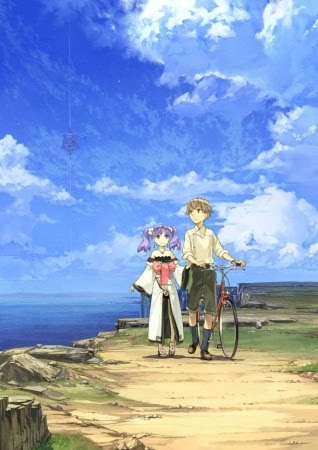
Blurring genre lines is one of my favorite aspects of Japanese animation. There doesn’t seem to a limit to the genre lines they’ll cross within a single show, the most common being the combination of Science Fiction and Fantasy. What we get in Fractale is a mash of maybe a dozen genres, too many to count, into a single story. But instead of the intersection points breeding interesting new ideas there is only cliché and self-reference. Fractale takes place in a far future Utopia governed by a massive data networked called Fractale. Clain, a young boy obsessed with obsolete technology, rescues a girl being pursued by terrorists. After meeting the girl Clain is tossed into an adventure that will lead him to unlock the dark secrets behind Fractale. 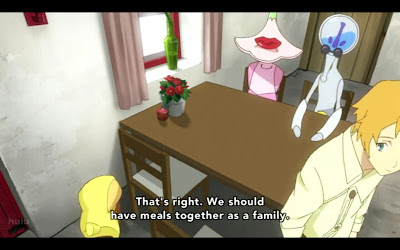
Fractale’s world is the strongest aspect of the show. The characters who live in Fractale are colorful, well designed avatars that can travel anywhere in the world connected by the Fractale network. Due to this ability people don’t stay in one place anymore but migrate around the country side. It is unfortunate that while Fractale is the name of the show we get to see little of the Utopian data network. Clain doesn’t use Fractale because he is a luddite obsessed with pre-fractale technology and he is tossed in with the rebels fairly early in the series which leaves almost no time spent in the wonderful world of Fractal. What little time is spent there is fantastic. It’s a world where anything is possible, where your avatar can be anything you want it to be, and the one extended sequence in a Fractale powered city was probably the most aesthetically pleasing part of the entire series.
Fractale, as an anime, feels like a jumble of genres and tropes glued together to form a single show. There is a lot to like about Fractale’s narrative and theme but it gets dragged down by clichés that I believe are brought on by Yutaka Yamamoto purposely wallowing in the tropes of the medium. In the first episode alone we get a protagonist who doesn’t fit in with the world, we get a beautiful girl who the protagonist saves, three bumbling villains, and an adorable little girl that the protagonist needs to take care of. Sure, this is happening in an interesting post-cyberpunk world but those elements have roots in anime going back to the 1980s. There is nothing interesting or original in the setup of the show.
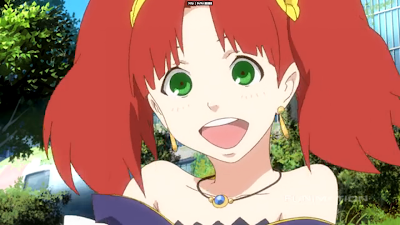 The characters are also subject to the same derivative problems. The protagonist falls in love with Phryne, the girl he saved, almost instantly and makes it his job to protect her. That becomes the single motivating factor for all his actions in the series. While that is an anime cliché there is some realism to it because of the way Clain has been living. Realistically, this is the first young girl that Clain has ever seen and there is probably an overwhelming fear that he might not see another woman in a long time living in the middle of nowhere and refusing to take advantage of Fractale. Even so, Clain is a bit of an anomaly because while the population of the planet doesn’t seem as large as it is today, there are children inhabiting the world of Fractale and Clain’s very existence implies that his problem is odd. So the explanation doesn’t really hold water except that Hiroki Azuma, original story creator, created a character that fit perfectly into that cliché without thinking about how the vast, network connected world’s effect on human relationships. What could have been an interesting narrative jumping point is squandered for a cheap cliché.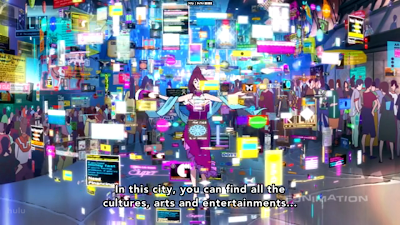
The key problem with Fractale is the show doesn’t know what it’s about. It spends time both praising and criticizing the hyper-connected world and although the people who are obsessed with Fractale are clearly portrayed negatively the anime doesn’t seem to approve of a world without Fractale either. The audience is never really given a clear view of the average Fractale user, with exception of Clain’s parents who seem to be kind; warm people that are as worried about their son just like any parent would be. They just aren’t physically present in the same meat space as Clain, but that never stops them from sitting down to a meal with their son. So while the author seemed to side with the anti-Fractale group I saw no real signs that Fractale itself was excessively harmful to the majority of humans.
Maybe that is the key to Fractale that is being missed because of the jumbled narrative. The main story is about a group of extreme luddites batting a group of extreme technophiles. It’s unfortunate that Yamamoto limits our view of this world to the two extremes because the vast majority of people live happy, normal lives under the rule of Fractale. The ending presses this point hard, and while I don’t want to ruin it, I felt that it was atonal for what was presented to the audience on screen. The result didn’t feel like it would come from two factions who went to war with each other. Rather than take the ending as a quick conclusion to the series I prefer to think of it as Yamamoto telling the audience that any extreme, perhaps, isn’t a good idea and definitely isn’t representative of the people as a whole. I’m probably giving Yamamoto too much credit considering that none of that was given to us in the actual narrative.
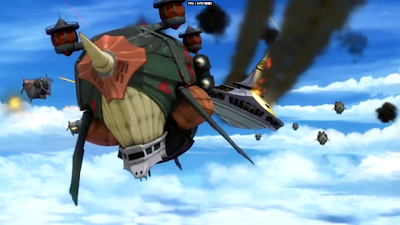 While Fractale offers an interesting world with some stunning animation the show is weighed down by anime cliché and Meta elements that give the show a patched together feeling. While it attempts to reach far and build an epic storyline, it fails to reach any new ground. Fractale isn’t awful, it is just a forgettable show and the community at large, including myself, has been harsher on Fractale because of the promise Yutaka Yamamoto gave to the audience. There is a quality series here, but it’s hidden under incompetent directing and no clear narrative vision.
Good
- Quality animation and in-Fractale character designs
- The one airship battle was awesome
Bad
- Characterization is convoluted and poorly thought out
- No clear vision of the world, despite relaying on the world to build the narrative
- Unclear theme or goal to the narrative.
- Weighted down with common anime cliché and meta-elements.
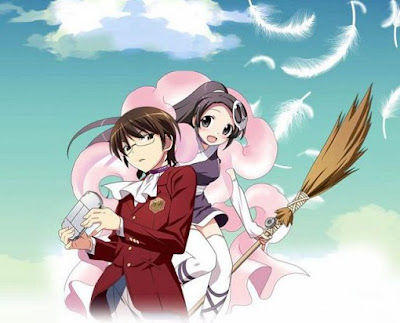

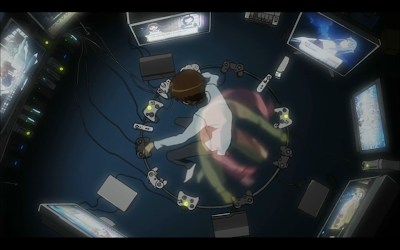

 What drags The World God Only Knows down are the one off episodes. In a 13 episodes series there are three painful filler episode and one none-arc episode that passes only because it helps establish characters. The author knows how to play with this world and the characters in the format he created for Keima’s targets, but stepping outside of that the characters lose their appeal. The jokes around Keima being a hardcore gamer work in the regular episodes because they are mixed with the rest of the narrative, but when we get two episodes dedicated to him playing games the joke is stomped to death in the first few minutes and the episode simply become a rehash of those two or three jokes repeated for twenty minutes. These episodes also allow the disgusting misogynistic nature of the series to come out, lacking the charm and quality of the official arcs.
 to show this to the average American they would either take the sweet cliché romances at face value or be offended by Keima’s attitude towards women. No one is going to wait around for someone to explain that the reason the clichés are paper thin but they are being used to poke fun at paper thin clichés. I can only end my personal indecision on The World God Only Knows by saying that it was effective at what it set out to do, use Keima and the clichés to create interesting and sweet romantic stories. If a person comes to the show not knowing that the show was parodying the tropes it used, then it would probably be unwatchable for them.
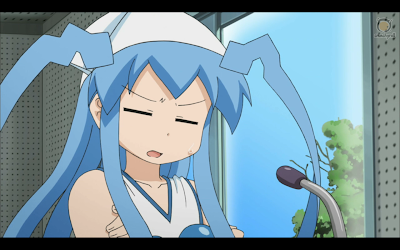
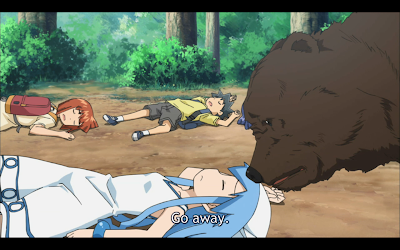 The supporting cast plays a large role in the humor of the series, but really they exist to place Squid Girl into situations where she has to react and confront a problem in a “squidly” manner. There is Sanae who develops an obsessive crush on Squid Girl, Cindy Campbell a US researcher who believes Squid Girl to be an alien, Chizuru who is a seemingly sweet girl until made angry, and Nagisa who is employed by the cafe and becomes terrified by the invader from the sea; a fact which Squid Girl couldn’t be happier with. Each character represents a single gag and when they appear a variant of that joke immediately happens, the writing is clever and each encounter is varied enough to hide repetition. While the characters are funny on their own the real joy is when they interact with Squid Girl. Squid Girl is unable to adapt to simple concepts so when she is faced with an absolutely mad group of people she doesn’t quite know how to process it, and the show continuously tosses wild elements at each other and just how they react. The result most is bizarre confrontations that are played as charming and humorous.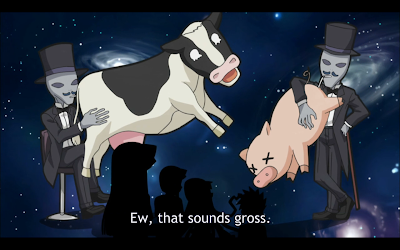
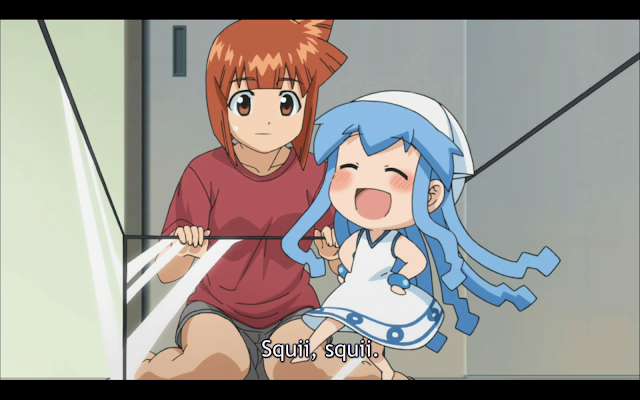 The final episode of the series attempted to cap it off with an emotional ending as Squid Girl loses her powers and leaves the tea house. It feels artificial and contrived, even as a person who has become a huge fan of the show and fallen absolutely in love with Squid Girl I wasn’t at all emotionally moved by Squid Girl leaving because it was obvious she was going to come back. I understand the need to have a neat ending to close the series but by dedicating two thirds of an episode to such an obvious plot line the only thing they accomplished was admitting they couldn’t write an effective ending to the show. They should have stayed the course and produced two high quality shorts, as we have come to expect, instead of such an obvious ploy for closure.


 Verdict: SoreMachi is a visually innovative and witty slice of life anime. The animation and direction propel what would be an average comedy series into a uniquely powerful piece that appears insightful beyond its content. At the core it is a well written comedy that has a well exploited mystery theme running through most of the jokes, plus its ability to portray Science Fiction elements in a deadpan slice of life tone brings an odd twist to this extremely enjoyable show.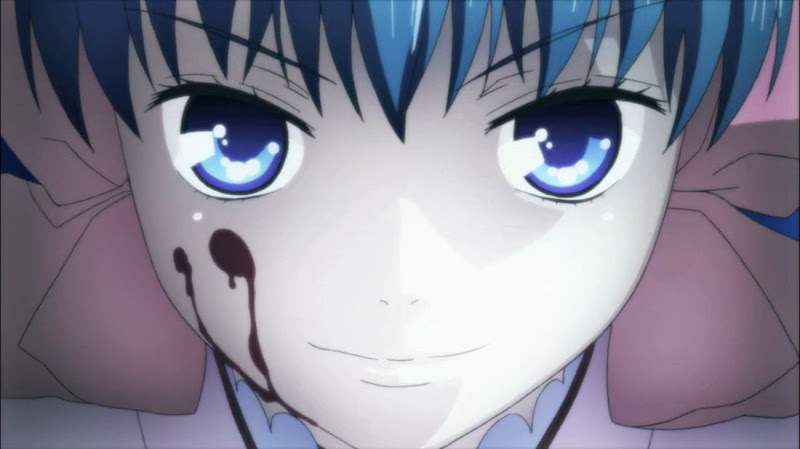

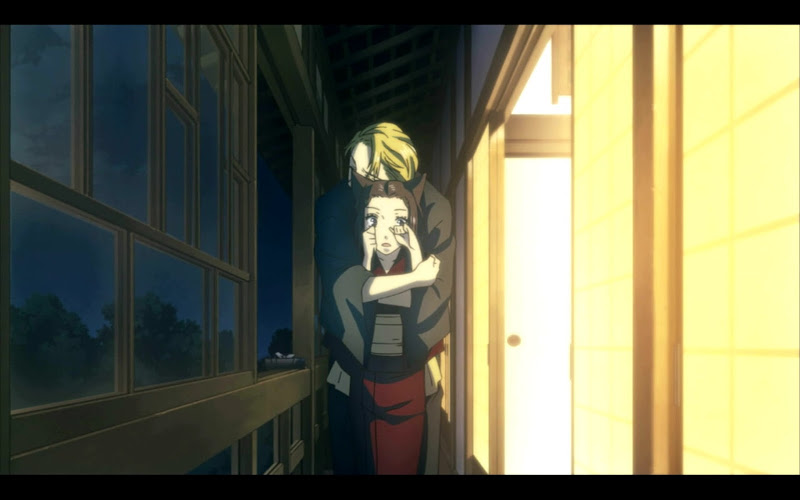
 struggle between old and new worlds all climax in a fantastic end. The issues of time play a factor but Otome Yokai Zakuro strength lies in the main cast, and Zakuro herself, more than the storyline. The show gives plenty of time to develop at least Zakuro’s character as it brings the narrative to a close, so much so that I can forgive some of the rushed elements. So much of the narrative is geared towards wrapping up the main thread that some of the larger thematic and conceptual elements of the series also get left in the dark.
 Otome Yokai Zakuro is a fantastic romance series with strong plot, world building, and characters. The overarching plot unravels a mystery based on the dynamic characters the show presents to the audience. However, even with those strong elements Otome Yokai Zakuro’s action becomes repetitive and strong thematic elements that start to develop early on become lost in the romantic story and lose their effect when the relationships between the characters attempts to be a metaphor for the old and new coexisting while the show forgets the basic set up of the narrative. The show becomes crunched for time causing a rushed, neatly tied up ending in place of something more genuine.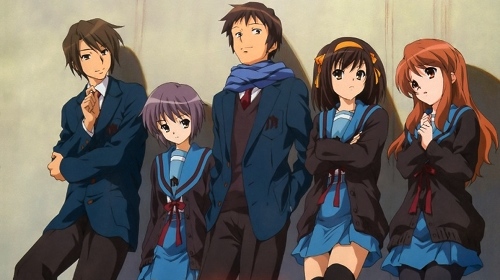
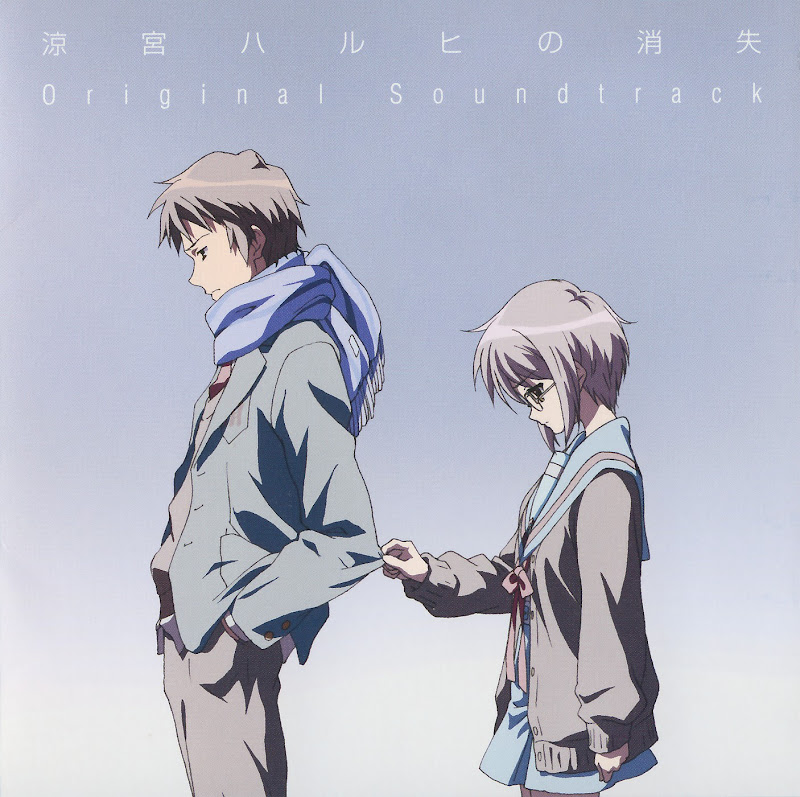
 feel long by the end. Elements that work in novels such as references past events constantly, long sequences of omnipotent narration, and wrapping up the narrative with long scenes of dialogue after the action is long over slowed the film down. As a Haruhi fan I was in love with every word that came out of every character’s mouth, maybe not -Esper guy-, but as an Anime fan the film obviously needed some serious script editing to improve the flow of the film and tighten u the dialogue for maximum effect in minimum time.
![occult%20academy[1]](http://lh6.ggpht.com/_lh4zKkFS1gg/TOL4p3dUAQI/AAAAAAAALBQ/zBJ3QsCW0vA/s800/occult%20academy.jpg "occult%20academy[1]")
![Bandaged[1]](http://lh4.ggpht.com/_lh4zKkFS1gg/TOL4qELJ9cI/AAAAAAAALBQ/aN-t4eV0ohw/s640/Bandaged.jpg "Bandaged[1]")
![Maya%20upset[1]](http://lh4.ggpht.com/_lh4zKkFS1gg/TOL4qH49a8I/AAAAAAAALBQ/FQFQ5Tz3x_w/s800/Maya%20upset.jpg "Maya%20upset[1]")
![Evil%20Witch[1]](http://lh4.ggpht.com/_lh4zKkFS1gg/TOL4qV3Uk4I/AAAAAAAALBQ/X32S9WoNbA0/s800/Evil%20Witch.jpg "Evil%20Witch[1]")
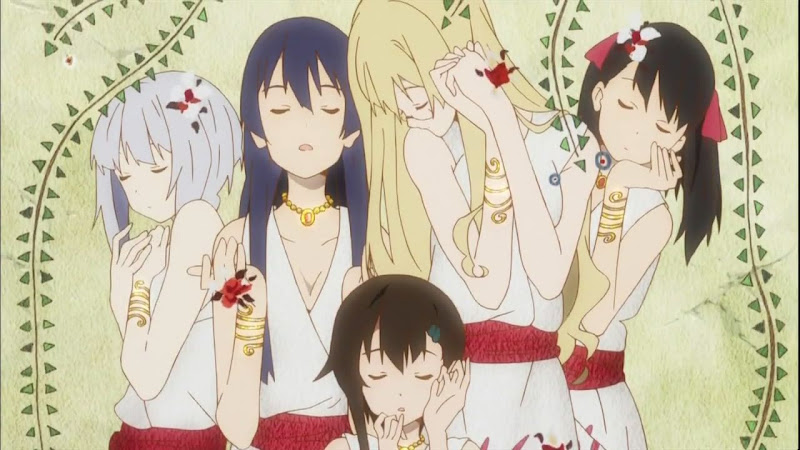



 Hollow Pursuits